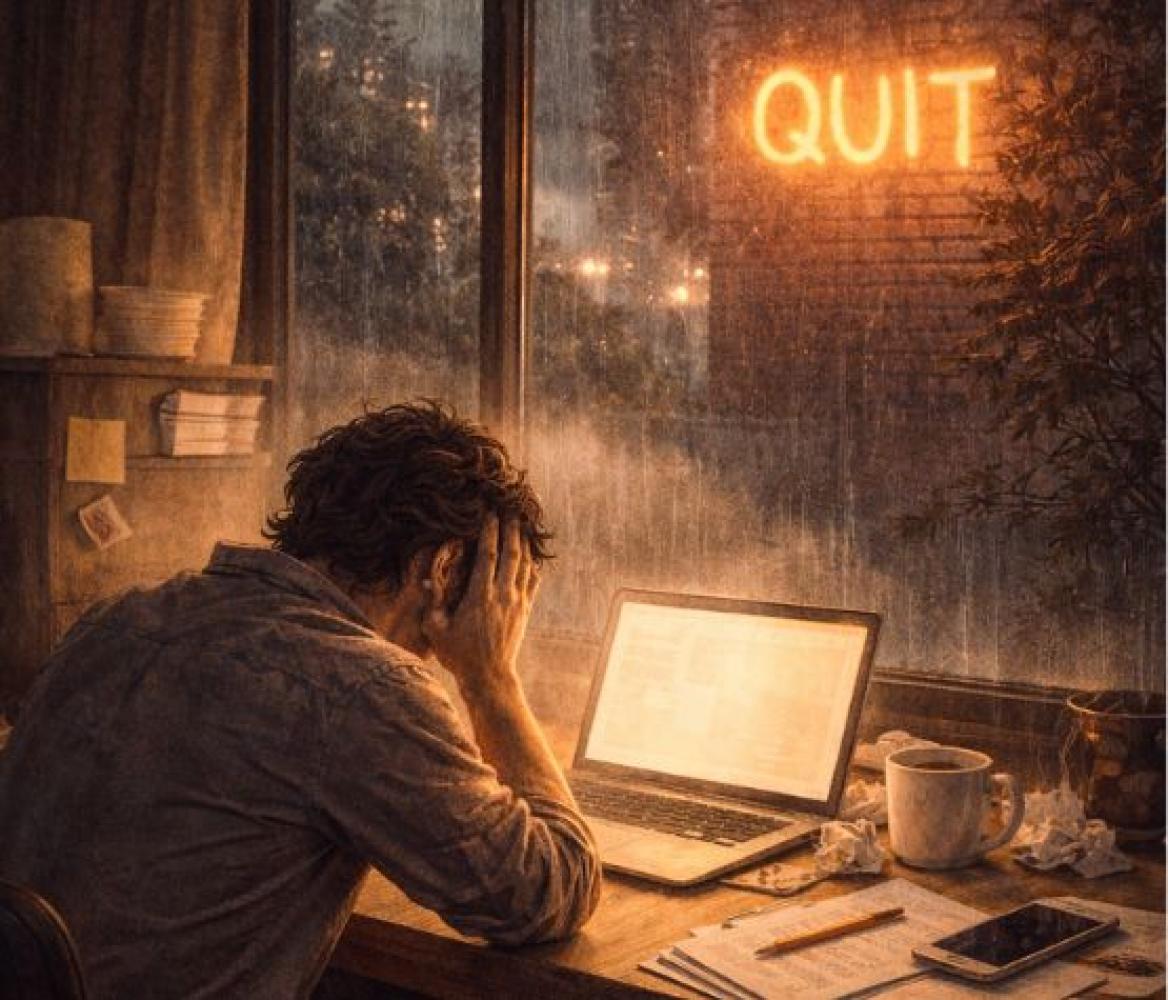
We’ve all been there. You are deep in the trenches of a project, a relationship, or a personal goal, and the "Return on Investment" has gone completely dark. The initial excitement has evaporated, the caffeine isn't hitting anymore, and you’re staring at a wall that looks suspiciously like a dead end.
Every fiber of your being is whispering—or perhaps screaming—a single word: Quit.
But here is the irony of human progress: The desire to give up is rarely a sign that you are failing. More often, it is the biological and psychological signal that you are exactly where you need to be for a breakthrough.
When we start something new, we are fueled by "beginner’s high." Our brains are flooded with dopamine because everything is fresh. But eventually, the novelty wears off, and the actual work begins. This is what sociologists often call "The Dip."
Why is it that the "shift" waits until we are at our lowest point? Because that is the moment you finally stop trying to "force" the outcome and start allowing the process to take over.
"The moment you are ready to quit is the moment you have finally exhausted your old ways of thinking. Only then can the new way begin."
When you reach the point of wanting to quit, you have effectively burned through your ego, your expectations, and your rigid plans. You are finally "empty" enough to pivot, to listen, or to try a radical new angle that you were too comfortable to see before.
The shift isn't just an external change; it’s an internal hardening of your resolve.
Not every struggle is a sign of an impending shift. Sometimes, quitting is the right move (a strategic pivot). To know the difference, ask yourself these three things:
If you are currently standing at the edge, looking for the exit sign, take a breath. That crushing weight isn't necessarily the ceiling coming down—it might just be the resistance of the door finally starting to swing open.
The most legendary stories don't end at the moment of exhaustion; they start there. The shift is coming. Don't leave five minutes before the miracle.

We live in an era of "Auto-Complete." Auto-complete for our emails, auto-complete for our code, and...
Read More
We live in a world obsessed with output. We track our steps, our screen time, and our billable hours...
Read More
It’s the moment every parent dreads, yet secretly hopes for. Your teenager walks into the room, shif...
Read More